Aging Gracefully on the water: How ILCA Masters Sailing Has Shifted Over 25 Years
For the past 25 years, I’ve had a front‑row seat to the evolution of ILCA Masters sailing at the Chesapeake Bay ILCA Masters Championship. First it was as an event manager when I wasn’t old enough to sail and later also as a competitor when I could join the fleet. Watching the fleet change over that span has been interesting, not just for what it says about our sport, but for what it reflects about broader trends in sailing across the country.
This particular event isn’t meant to represent every region or every fleet, but it serves as a revealing microcosm of a national shift that’s been unfolding quietly and steadily. The data tells a clear story, and the patterns behind it offer insight into how the sport is aging, and what forces may be shaping the Masters landscape today.
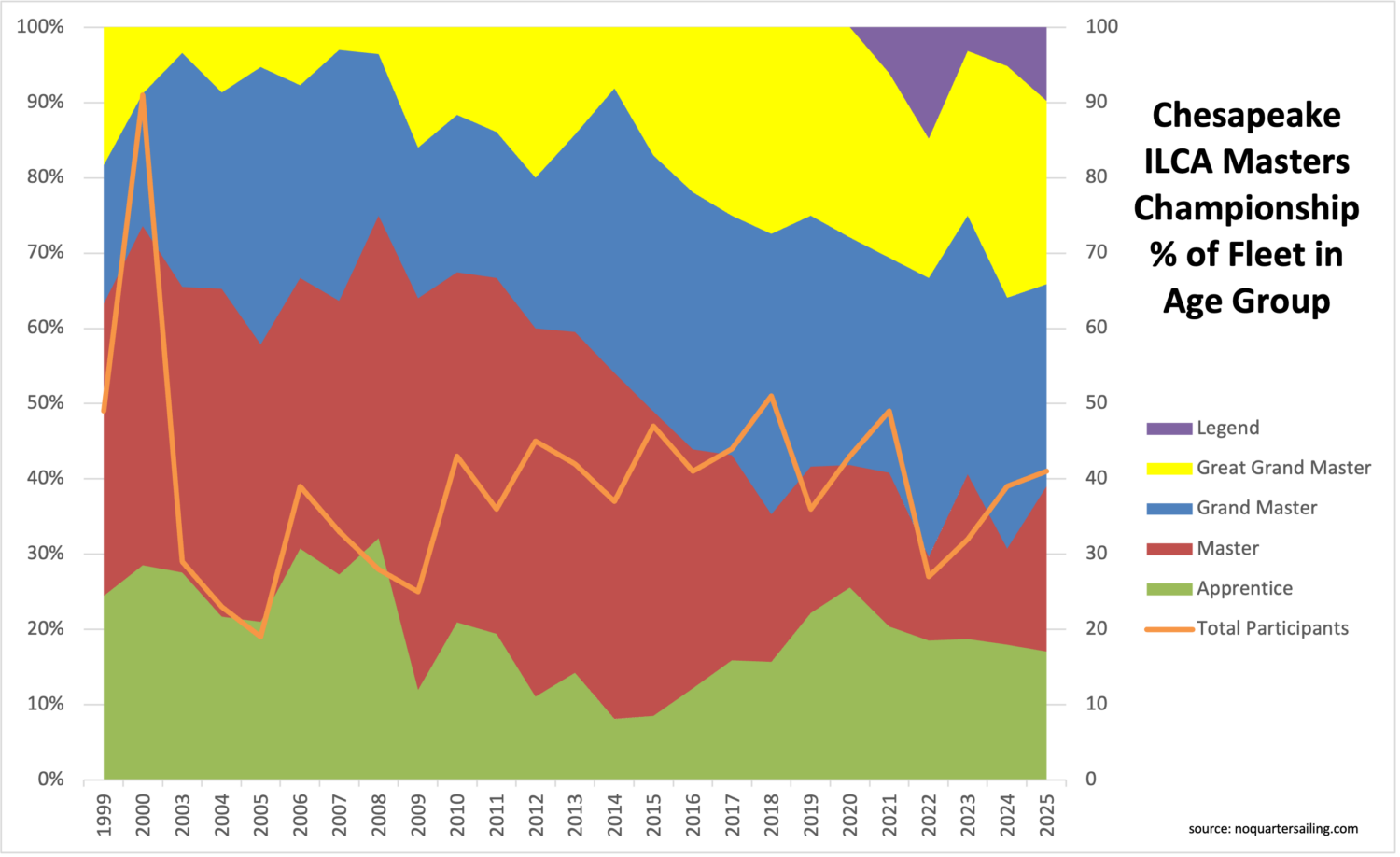
Looking at the rank distribution from 1999 to 2025, the trend is unmistakable: the ILCA Masters fleet is getting older.
In 1999, the Apprentice (then 35-44) and Master (45-54) categories made up 63% of the fleet. By 2025, those groups – now 30-44 and 45-54 – represent just 39%.
Meanwhile, the Grand Master (55-64) and Great Grand Master (65-74) categories have steadily expanded, now comprising more than half of all sailors. And the newly separated Legend (75+) group has grown to 8% of the fleet.
Also note the minimum age for Apprentices shifted from 35 to 30 starting in 2022 and legends were broken out from the Great Grand Masters starting in 2021. 2025 was the first year of separate ILCA 6 & 7 starts.
Why the Shift is Happening
Several forces – cultural, economic, and demographic – are shaping this long-term transformation.
Longevity in the Sport
Sailing is uniquely suited to lifelong participation. Unlike many sports where age quickly becomes a limiting factor, ILCA sailors often remain competitive well into their 70s. Experience, tactical awareness, and boat-handling finesse often outweigh raw athleticism.
Better Health and Fitness
Today’s older sailors are healthier, fitter, and more active than previous generations. Advances in training, nutrition, and medical care have extended the competitive lifespan of athletes across many sports, and ILCA Masters sailors are benefiting from that trend.
Community and Camaraderie
Masters regattas are more than competitions – they’re gatherings of friends who’ve shared decades on the water. The social fabric of these events is a powerful draw, keeping sailors engaged long after their “peak athletic years.”
Barriers for Younger Sailors
For sailors in their 30s and 40s, life often gets in the way. Careers, young families, and financial pressures make it harder to travel to regattas or commit to a full season. The Apprentice category’s decline reflects these realities.

What This Means for the Future
The aging of the ILCA Masters fleet is not a crisis, but it is a trend with implications. Older sailors bring depth, experience, and stability to the sport. Yet the long-term health of the Masters community will depend on finding ways to make participation more accessible for younger adults – whether through regional events, flexible formats, or targeted outreach.
For now, the story is one of endurance. The Masters fleet is older than it was 25 years ago, but it is also thriving, competitive, and deeply committed. The sailors on the line today represent a generation that has stayed with the sport, adapted with it, and helped define what Masters sailing looks like in the United States.
If you’d like to be part of the 2026 edition of the Chesapeake Bay ILCA Masters Championship – mark your calendar for October 3-4, 2026. More info at: https://www.fbyc.net/events/2026/261003-onedesign-45th-chesapeake-bay-ilca-masters-championship/